 By Collins Ikechukwu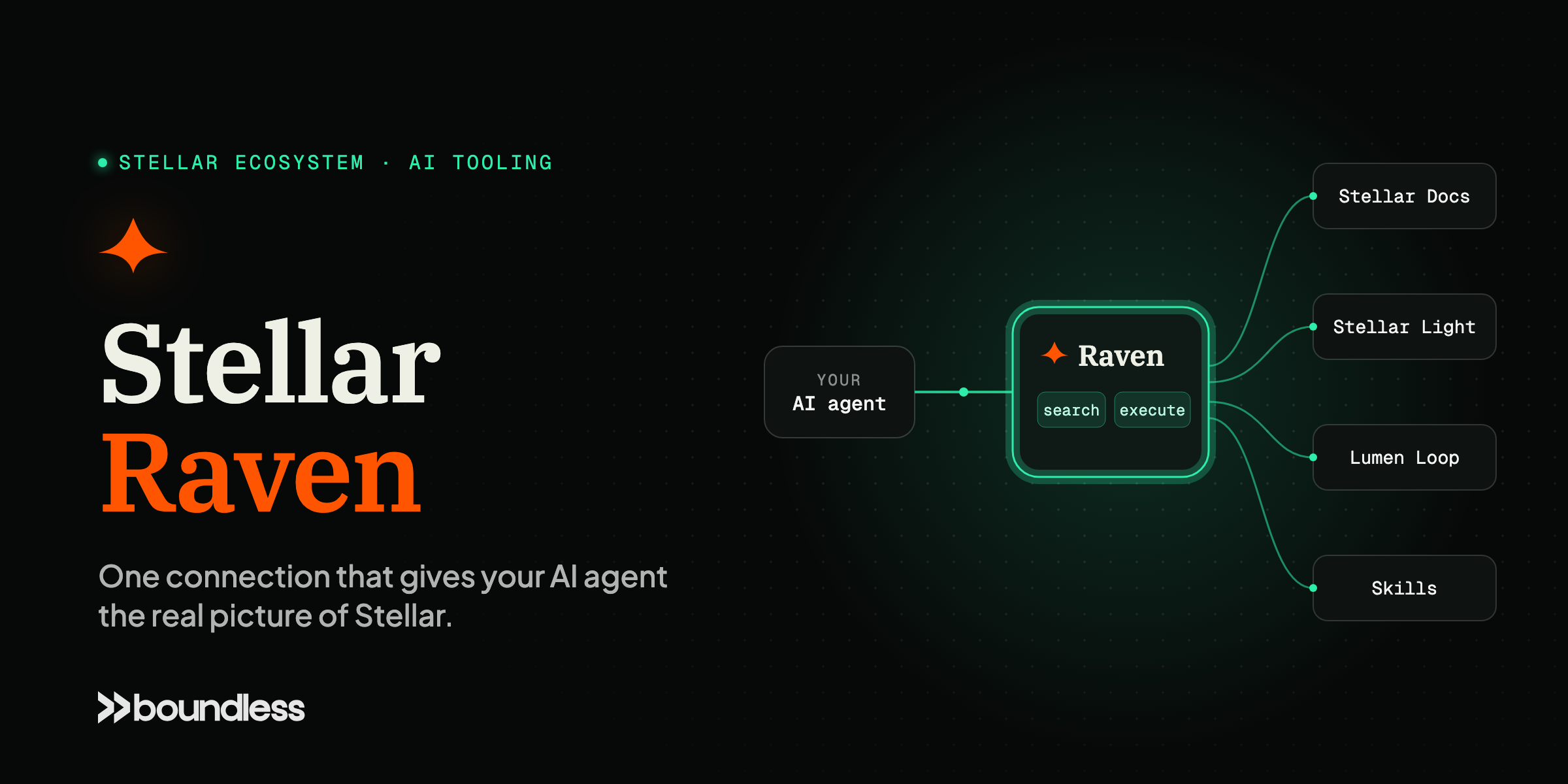
Ask an AI coding assistant how to build on Stellar and there is a good chance you get an answer that sounds right and is a couple of years out of date. It suggests an SDK call that has since been deprecated, reaches for Horizon where RPC is now the better fit, or recommends a project that no longer exists while missing the ones that launched last month.
The model is usually not the problem. The context is.
Stellar is an open, fast-moving ecosystem. The truth about it is spread across the official docs, hundreds of GitHub repos, Stellar Community Fund submissions, Discord threads, podcasts, and project websites. Some of that is current. A lot of it is not. A model trained on all of it has no reliable way to tell the difference.
Stellar Raven is the Stellar Development Foundation's answer to that problem, and it is one of the more useful things to land in the ecosystem this year.
So, What Is Raven?
Raven is a remote MCP server for AI agents. MCP, the Model Context Protocol, is the standard that lets tools like Claude, Cursor, VS Code, and Codex connect to outside data sources. Connect Raven once, and your agent gets the official Stellar docs, live ecosystem data, community research, and tested build guides through a single connection.
A few quick facts:
- Who built it: Tyler van der Hoeven (@kalepail) at SDF. It was presented to the community at the Stellar Developers Meeting on July 16, 2026.
- Live since: July 2, 2026.
- Setup: one browser sign-in. No API keys to manage.
- Open source: the code is on GitHub.
- Try it first: the Raven playground lets you ask it questions in the browser before connecting anything. You will need to sign in.
The official Building with AI page on Stellar's developer docs now lists Raven as the recommended starting point, ahead of the static llms.txt file and the installable Stellar Skills. The difference is simple. Those are files you load into your agent. Raven is a live service your agent talks to.
Where Does the Information Come From?
Raven does not try to own all of this knowledge itself. It pulls together sources the ecosystem already maintains and puts them behind one interface. There are four groups:
| Source | What it covers |
|---|---|
| Stellar Docs | Official protocol docs, SDKs, CLI, smart contracts, RPC, anchors, and wallets |
| Stellar Light | A live map of the ecosystem: projects, graded repos, builders, hackathon entries, audits, and stablecoins |
| Lumen Loop | Community knowledge: articles, research, talks, podcasts, events, and SCF submissions |
| Skills | Step-by-step guides for building, integrating, security, and working with data |
We looked at Raven's live catalog while writing this. As of September 16, it holds 60 data operations and 20 skills. The skills come from several teams, not only SDF. There are SDF guides for smart contracts, assets, dApps, cross-chain work, ZK proofs, agent payments, and standards. OpenZeppelin contributes guides for setting up, securing, and upgrading Stellar contracts. Lumen Loop adds research workflows like project due diligence and tracking SCF submissions.
According to the Raven homepage, the ecosystem data covers more than 920 projects and 2,300 graded repositories.
Why the Design Matters
This is the part we find most interesting as builders.
Raven has 60 operations, but it gives your agent only two tools: search and execute.
The obvious way to build something like this would be to expose all 60 operations as separate tools. The problem is that every tool description takes up space in the agent's working memory on every single turn, whether it is used or not. Sixty of them eat a big chunk of that space before the agent has done any real work. It also means one round trip to the model for every piece of data.
Raven takes a different route.
searchfinds the operations and guides that match what the agent is trying to do, and returns only their descriptions.executelets the agent write a small JavaScript script that calls those operations, often several at once, and returns just the parts it needs. The script runs in a locked-down sandbox with no internet access, and every call is checked against Raven's catalog.
In practice, a single request can look like this:
async () => {
  const [project, coverage] = await Promise.all([
    scout.searchProjects({ q: "Raven", limit: 1 }),
    lumenloop.search_content_semantic({
      query: "Stellar Raven MCP server",
      types: ["articles", "research"],
      limit: 6,
    }),
  ]);

  return {
    raven: project.ok ? project.data.projects[0]?.status : null,
    coverage: coverage.ok
      ? coverage.data.items.map((i) => ({ title: i.title, url: i.url }))
      : coverage.error,
  };
};
Two sources, one round trip, and a small, clean result. The agent only pays attention to what it asked for.
It Is Built to Say "I Don't Know"
The other design choice we like is how Raven handles missing information.
Every call returns either a result or a clear error. One kind of error, called soft-empty, means "this source had nothing on that." Raven treats that as inconclusive, not as proof that something does not exist. Its instructions push agents to say "not found in these sources" instead of "this doesn't exist", to attach a date to any number that changes over time, and to check other sources before concluding something is missing.
That sounds like a small detail. It is not. The most common way AI assistants mislead people is not by missing a fact. It is by confidently stating that something is not there. Building that caution into the tool itself, rather than hoping a prompt covers it, is the right approach.
How the Team Keeps It Accurate
A tool like this is only as good as its answers, and the team shared how they measure that during the July developer meeting.
They built a set of 500 real questions and answers taken from Stellar Stack Exchange and Discord. Raven is tested against that set, and every miss is traced back to the specific source responsible, whether that is the docs, the ecosystem directory, or a particular guide. That turns "the AI got it wrong" into a concrete fix.
Two examples came up. Early on, Raven missed Etherfuse when asked about asset issuers in Latin America, and missed Sushi when asked about swap platforms. Both are now part of the test set.
What to Keep in Mind
Raven is useful today, but it is still young. A few things worth knowing:
- You need to sign in, even to use the playground.
- You may see two addresses. Stellar's docs use
raven.stellar.buzz, while the Raven homepage now showsraven.stellar.org. Both work today. - Search results are leads, not facts. Raven labels broad search results as candidates to verify, and your agent should treat them that way.
- It only knows what its sources know. If a project is not listed in Stellar Light or Lumen Loop, Raven will not know about it. That means it is not tracked there, not that it does not exist.
What This Means for Builders
When we started planning an assistant inside Boundless, one of the open questions was how it should handle general Stellar questions. Maintaining our own Stellar knowledge base was never going to be the best use of our time. A shared, open source context layer like Raven changes that decision. Teams can focus on their own product and plug into one well-maintained source of truth for everything else.
The bigger picture matters too. More and more developers now learn a new ecosystem by asking an AI assistant rather than reading the docs directly. An ecosystem whose information is outdated inside those assistants will quietly lose builders to one whose information is current. Stellar is one of the first ecosystems to ship a real answer to that, and to make it open source.
How to Get Started
If you use Claude Code, run:
claude mcp add --transport http stellar-raven "https://raven.stellar.buzz/mcp"
Then type /mcp, choose stellar-raven, and sign in through your browser. Cursor, VS Code, and Codex are supported too, and the Raven docs cover each one.
Our tip: start by asking it something you already know the answer to. It is the fastest way to learn how far to trust it.
If you are getting ready for HackMeridian in Lisbon on October 25 and 26, SDF is running a four-part livestream series on building with AI and Raven, starting September 24. For questions, the #raven channel in the Stellar Developers Discord is the place to go.
At Boundless, we build on Stellar and host hackathons, bounties, grants, and crowdfunding for builders in the ecosystem. Tools like Raven make it easier for new builders to get from idea to working product, and that is exactly who we want to see on the platform.
Have you tried Raven yet? Tell us what you asked it.
Share this on:
Want early access?
Get early access to the latest tools, hackathons, and builder programs inside the Boundless ecosystem.